At erasedgraves.ghana-net.com, (https://ghana-net.com) we delve into the rich yet complex history of the Osu Military Cemetery in Accra, Ghana. Our mission is to unveil the forgotten stories behind the graves that hold the memories of soldiers, colonial-era individuals, and children, reminding us of the sacrifices and erasures of our past. Join us in exploring this historical landmark and its significance.
Osu Military Cemetery · Christiansborg War Cemetery · Accra, Ghana
Three minutes from Ghana's Parliament House lies a row of about fifty soldiers' graves. Every name plate has been torn out of the concrete. Every regimental badge has been broken away. One stone was too hard to strip: it still carries the name of a Gold Coast corporal who died in February 1948. Elsewhere in the same cemetery, an old soldier's grave has been given to someone else. This website documents what is there, what has been taken, and who might still be looking for the men who lie here.
Listen The evidence Timeline The people What we know Questions Families Visit
This scandal can no longer be concealed.
The full story of the erased row: what was found, what was taken, and why it matters.
A walk to the erased row, a few minutes from the seat of Ghana's government.
Where Danish cannons first boomed in the 1550s, trading gold and souls under a relentless sun, there's a silence deeper than the Atlantic. Osu Military Cemetery: rows of stones like forgotten chess pieces…
No adjectives needed. These are the stones as they stand today.
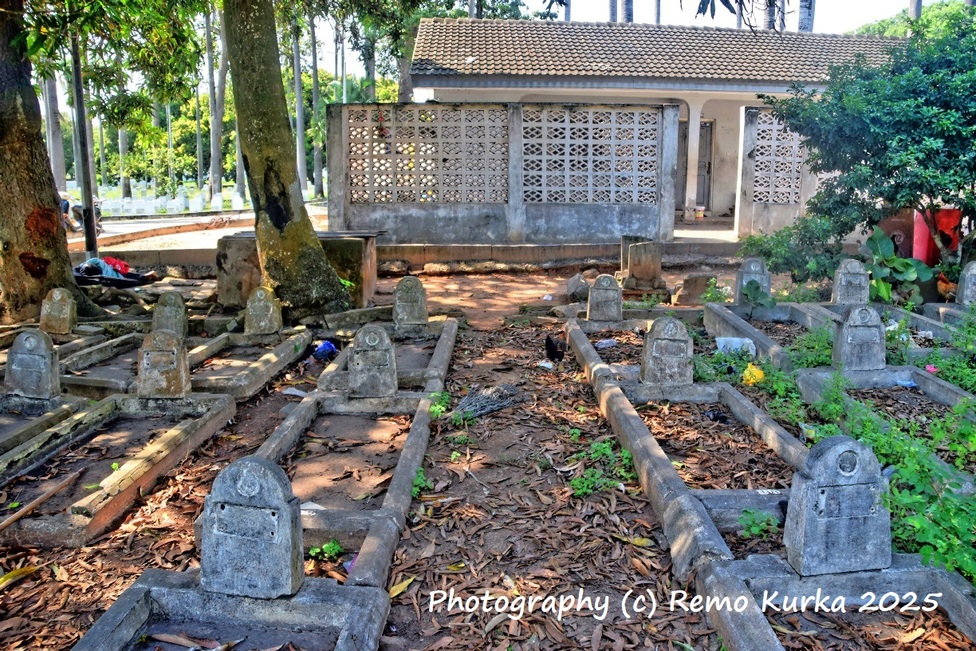
The erased row. Each headstone once held a name plate set into the concrete and a regimental badge above it. Both have been broken out, leaving empty recesses, tool marks and the imprint of the badge. Photo: Remo Kurka, 2025.
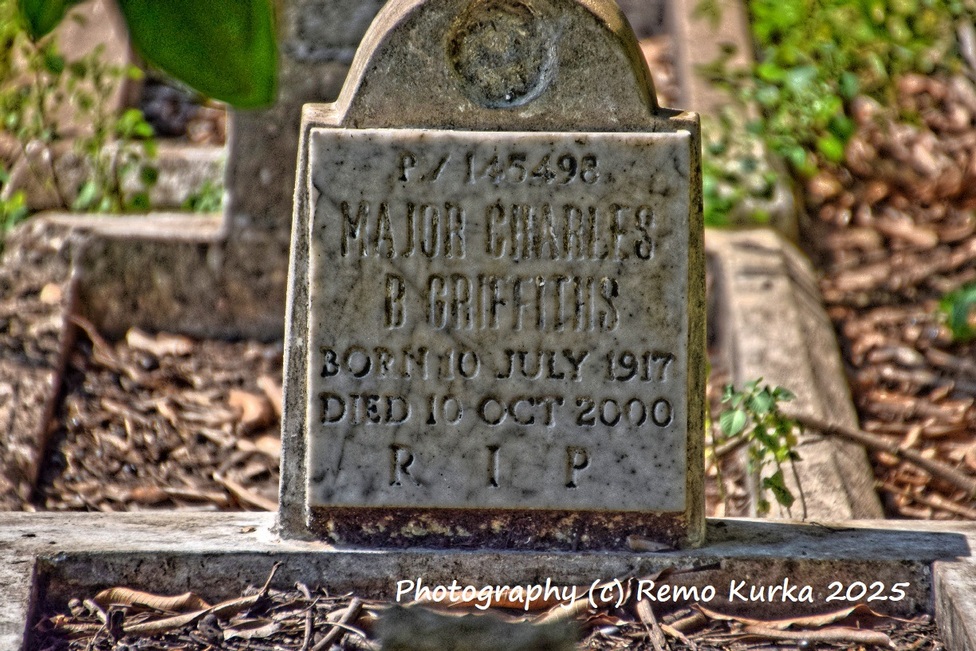
An overwritten grave. Major Charles B. Griffiths, born 10 July 1917, died 10 October 2000. His marble plate sits on an older headstone of the same type as the erased row, with the worn imprint of a badge still visible above it. The first soldier's name is gone. Photo: Remo Kurka, 2025.
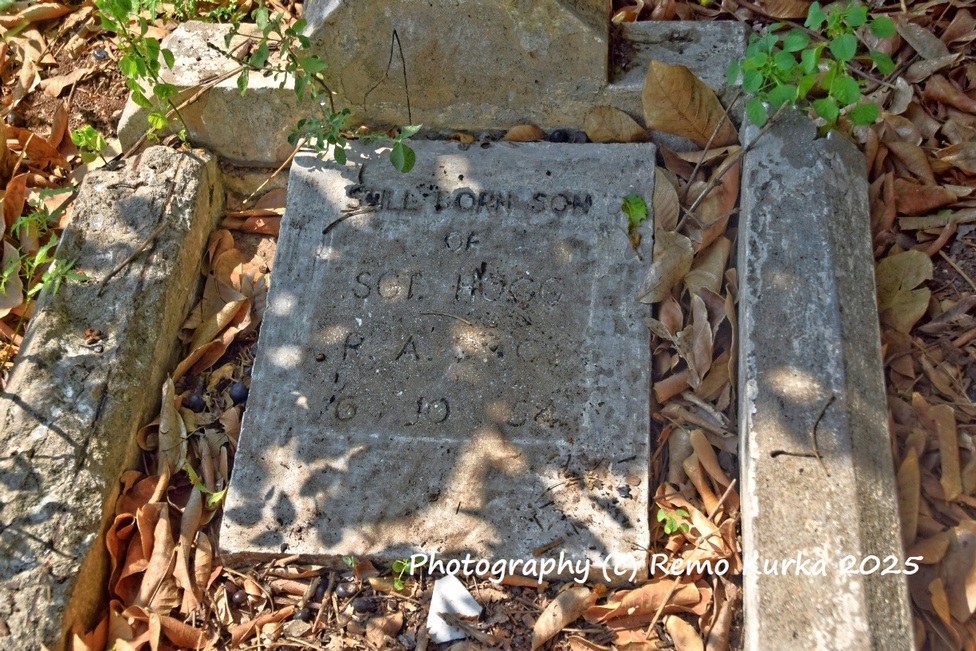
Children in a military cemetery. Graves of children from the 1950s, most likely the sons and daughters of servicemen stationed in the Gold Coast before independence. Photo: Remo Kurka, 2025.
The one name they could not remove
In the middle of the erased row, one plate survived: G.C. 73047 · Cpl. Akrong Robert · Died 14 Feb 48 · HQ W.A.C. A Gold Coast army number, a corporal at Headquarters, West Africa Command. His stone is the key to dating the whole row.
1939–1947 Soldiers who die in the Second World War are buried in the Commonwealth section. The Commonwealth War Graves Commission cares for war dead up to 31 December 1947. Their graves are maintained to this day.
14 Feb 1948 Corporal Akrong Robert of Headquarters, West Africa Command, dies, six weeks after the CWGC cut-off. His grave falls outside its care.
28 Feb 1948 Two weeks later, police shoot three Gold Coast ex-servicemen at the Christiansborg crossroads, a short walk away. Riots follow; the road to independence begins.
1950s Children of servicemen are buried in the cemetery, among them Darling Terry, who lived fourteen months.
6 Mar 1957 Ghana becomes independent. The colonial army becomes the Ghana Armed Forces, and responsibility for these graves passes into Ghanaian hands.
20 Aug 1963 Richard Sauvé, born in Quebec City, dies accidentally at Teshie Camp and is buried here.
10 Oct 2000 Major Charles B. Griffiths dies. He is buried in a grave that already held an older soldier.
2025 The erased row, the surviving name and the overwritten grave are photographed and documented for this website.
Every name we can still read, and the stories behind them.
Osu Military Cemetery is officially Ghana's principal burial ground for soldiers and service members. Its Commonwealth section, known to the Commonwealth War Graves Commission as Christiansborg War Cemetery, holds the graves of soldiers from the Second World War, cared for under international standards. That part of the cemetery is clean, mown and named.
Behind it lies another part, which tells a different story: of graves stripped of their identity, of children buried among soldiers, and of old graves reused for new burials. Officially, the cemetery preserves Ghana's military heritage. In practice, part of that heritage has been removed, and nobody has explained why.
The Hidden Truth of Osu Military Cemetery, Accra
Not an isolated case
In 2021 the Commonwealth War Graves Commission acknowledged that tens of thousands of African and Asian servicemen from both world wars had been commemorated unequally, or not at all. What remains at Osu continues that story past 1947, at the point where even the commission stopped being responsible.
These questions have been or will be put in writing. Each answer, or each silence, will be published here.
Somewhere, a grandchild in the Volta Region, in Aberdeen or in Quebec may still be looking for a grandfather who never came home. If your family lost a soldier, an officer, a child or a civilian who was buried in Accra in the 1940s, 1950s or 1960s, please get in touch. Names, service numbers, letters and old photographs can help give the nameless their names back.
The cemetery lies in Osu, Accra, a few minutes on foot from Parliament House and close to Osu Castle. Taxis and ride-hailing apps know it as Osu Cemetery. Please behave as you would in any cemetery: quietly, and with respect for families visiting their dead. Ask at the gate before taking photographs, and never photograph military installations or soldiers on duty in the surrounding area.
Guided visits on request
We can arrange a visit to the cemetery with a local guide in Accra who knows the graves documented on this website. Message us on WhatsApp at +233 54 994 2584 or write to info@ghana-net.com. For wider tours of Accra and the coast, entrance fees are included in the tour price; tips are not included but always welcome.
1824 - 1905 War Cemetery Cape Coast Osu Castle - 300+ Hidden mass Grave Hidden Graves at James Fort
Every grave on this website was photographed on site by Remo Kurka, who has documented Ghana's history and heritage since 2000. Inscriptions are transcribed exactly as they appear. Where something cannot be read or proven, we say so. Dates and context are checked against published records, including those of the Commonwealth War Graves Commission. Corrections and additional information are always welcome.
Updated and fact-checked: 15 October 2026.
We offer comprehensive research reports on the graves, focusing on their historical contexts and the narratives they hold. Adding more context, when available!
Our outreach aims to educate the public about the cemetery's history, significance, and ongoing preservation efforts. Get involved! You are welcome!
We advocate for and participate in conservation efforts to preserve the integrity and memory of the cemetery. Not just the favorite parts of!
Unravel the stories behind Osu Military Cemetery.










Osu Military Cemetery, established during the Second World War, serves as Ghana's principal burial ground for soldiers and service members. It includes a Commonwealth section that honors the graves of Allied soldiers from the 1940s, preserved under international oversight as a testament to their sacrifices during World War II. However, it also contains other memorials that tell a troubling story of erasure and neglect concerning Ghana's colonial history and diverse burials. This dual narrative makes Osu Cemetery a significant site for exploring both military heritage and hidden histories in Accra. The cemetery not only recognizes military sacrifices but also becomes a focal point for understanding the complexity of Ghana’s past, including its experiences with colonialism and the impact of historical memory on contemporary society. For more detailed findings and historical research, engage with the multimedia resources displayed on our site or contact our team for an in-depth exploration of the cemetery's significance.
Yes, Osu Military Cemetery houses several noteworthy graves, including those of Allied soldiers from World War II, whose sites are maintained under international standards. Additionally, there are graves that belong to children, dating back to the 1950s, which raise questions about the cemetery's designation solely for military burials. Furthermore, there are colonial graves that have been systematically altered, with names and insignia erased, indicating a historical narrative that is often overlooked. The cemetery's varied plots offer visitors a chance to reflect on these stories, and we encourage those who are interested in learning more to visit and explore these remarkable sites.
To learn more about Osu Military Cemetery and its historical significance, please explore our website, where we offer a variety of multimedia resources, including *guided tours (Please contact us, for available dates, at lease 2 weeks in advance!) and photographic documentation of the cemetery's unique aspects. You can reach out directly via our contact details provided on the site (Contact Form is best, or WhatsApp. Your inquiries can contribute to a broader understanding of this pivotal location in Accra.
As a visitor and supporter, you can contribute to preserving the history of Osu Military Cemetery by engaging with our educational initiatives, sharing your experiences, and advocating for broader dialogue about the cemetery's narratives. Donations, volunteer support for restoration projects are welcomed. Please check our 'Get Involved' section for more information on volunteering opportunities, guided tours (at request), and ways you can support this website’s mission of remembrance and historical education.